Showing posts with label Lesbian. Show all posts

Friday, July 9, 2010

Excerpts from The Mee Street Chronicles: "Predators"


Copyright 2007-AllRights Reserved

Introduction to "Predators" from The Mee Street Chronicles

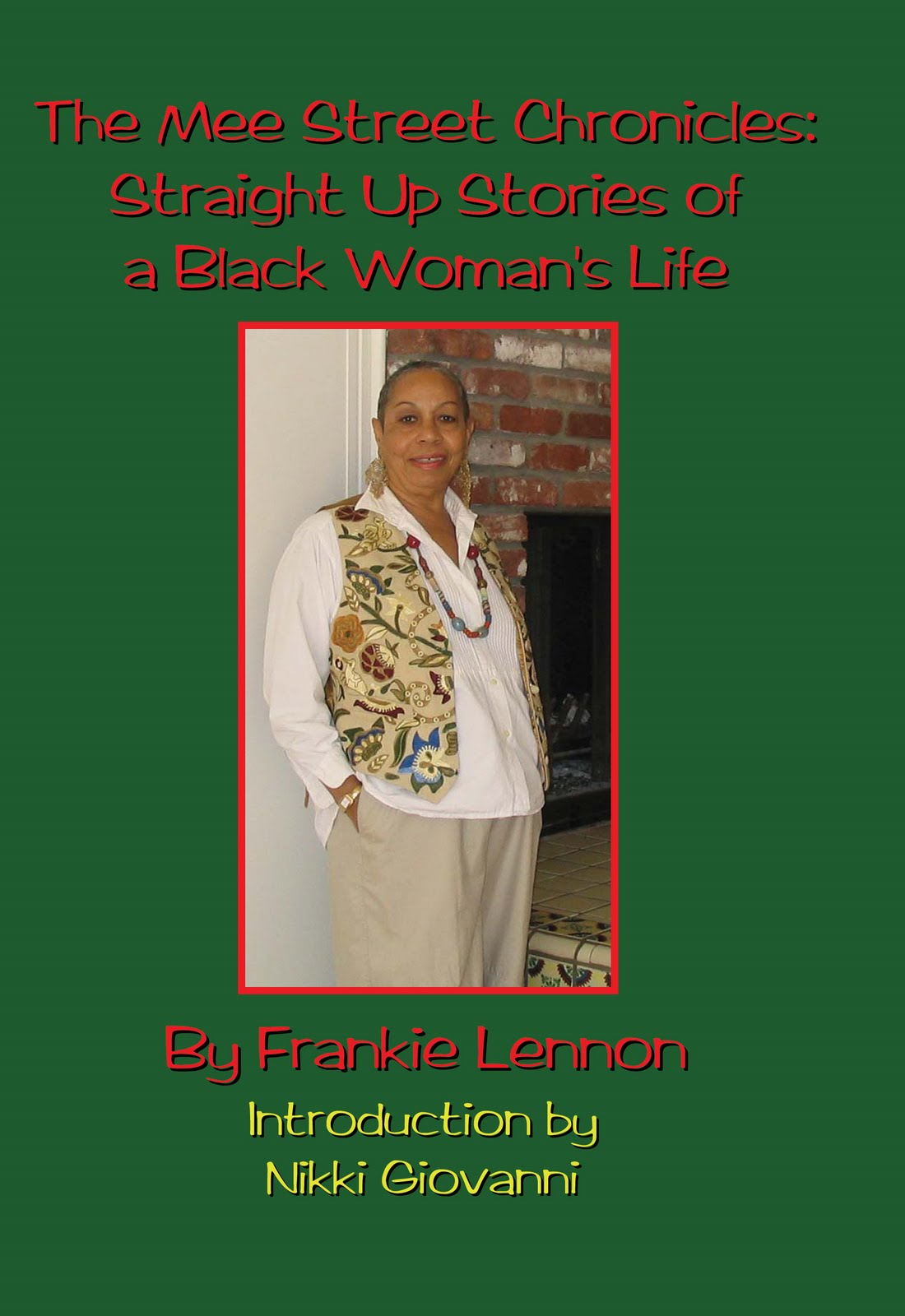
The excerpt below is from the story, “Predators,” in my memoir, The Mee St. Chronicles: Straight Up Stories of a Black Woman’s Life. My memoir tells you stories about my battle to claim my own life and sexual identity. This story is about a time when I was living as a closeted Lesbian, masquerading as a heterosexual. The Anita Bryant campaign, which served as catalyst for what happened that day in the bar, was going full throttle in the 1970's. This is a story of how that noxious campaign affected me.

"Predators"

"Homosexuality is not a deviation; it is a variation. And people need to know that."
Peter J. Gomes, Minister


Allen's black and white television sat on a beer cooler in a corner behind the bar, and you couldn't really see it unless you were sitting almost on top of it. From where I usually sat at the bar, I could see it fine if it was on. Today it was, and I was watching Les build my drink when the CBS Evening News came on. The anchor, Walter Cronkite, always distinguished, always credible, opened with the story of the "Save Our Children" campaign. It had started a short while ago, Cronkite said, pausing to glance down at the sheaf of papers in his hand, with Anita Bryant and her organization pushing for Miami to repeal the city ordinance prohibiting discrimination against homosexuals.

As soon as the word homosexual rolled out of Cronkite's mouth in basso tones, everybody seemed to come to instant attention. I shifted my eyes away from Les to the television broadcast, feeling everything inside me go stock still, just like a rabbit that's caught the scent of danger in high grass.

Out of the corner of my eye, I could see Katie, the waitress, headed for the jukebox, but Cecil, sitting at a table behind me, stopped her.

"Wait up, " he said. "I wanna hear the news." Katie shrugged and backed off.

That was unusual. Watching the news got very low priority even when there were only a handful of us at Allen's, so my nerve endings went on alert. Plus, I'd heard about Bryant's campaign. Which in itself was enough to get anxiety skipping through my veins. The campaign was getting a lot of national play and in Evansville, people were paying attention. At the very least, conversations gave it a passing nod if not full blown commentary. Not long ago, a man that I'd thought was open-minded and liberal had stunned me.

“Anita Bryant is right,” he'd raged after I'd asked him what he thought about her campaign. “That scum should be hunted down and put in a concentration camp somewhere away from normal people.” I particularly remembered his eyes while he'd said it. They'd gone hard and black and lightless. It was his eyes that had frightened me the most. He'd shown me his Mr. Hyde face, a part of him that I didn't know. And that part had drawn a line of separation in the sand with me standing one side and him on the other although he didn't know it. Didn't know about Stacey, about my woman dreams, about the real me I kept chained in secret corners. Nobody here did.

Glancing around, I realized that only a couple of familiar faces, the regulars that made Allen's so comfortable for me, were here today. Clyde, on the barstool in the corner and John, next to him. The rest—Cecil, Sonny, Nance, Gloria, and Betty—came in less often. As always Les was behind the bar and Katie was waiting tables, but there were a few others that I didn't know. For some reason, without the regulars that I knew so well, Allen's felt less cozy, less like home. Was there a chill in the air? I pulled my cardigan sweater closer around my chest.

On camera, Cronkite reminded us that aside from being a Miss America runner-up, Anita Bryant was best known as spokeswoman for Florida orange juice commercials. Bryant had gotten famous for telling the television audience, "A day without Florida orange juice is a day without sunshine."

Now, I thought to myself, she'd switched to selling something else. Something dark. I could hear aggravated murmurs from Cecil and the other guys sitting at his table. I drew in a ragged breath. Keeping up my camouflage was harder with Anita Bryant stirring things up. Where was my drink? I glanced at Les; he was moving in slow motion.

Cronkite went to a film clip of Bryant at a Midwestern news conference. A newsman asked about her motives for the campaign. Surrounded by microphones, the dark-haired, former beauty queen beamed at the camera and opened her mouth to oblige.

"Since homosexuals cannot reproduce," she said, striking a tone of both sincerity and loathing, "they must recruit children to freshen their ranks. We must not allow them to continue."

I clinched my fist, furious, thinking: "How can she get away with saying a pure lie like that?"

Somebody, a woman's voice, growled: "One of them mess wit my baby and he gonna get his ass kicked!"

I blew out a frustrated breath. What Bryant was saying boiled down to a load of crap. You didn’t choose or get recruited like you were joining the army or some kind of club. You were born the way you were born.

I thought about Stacey and rubbed the palm of my hand across my lips. Nobody had recruited me into being attracted to women. Nobody had forced me to love her. That admission woke up The Corners, the place, at the back of my mind, where I'd vaulted my secrets. Like autumn leaves, they began to crackle and rustle. Which served to unnerve me even more than Anita Bryant. Mostly, I could keep them quiet and still as a tomb.

On screen, you could see the reporters scribbling furiously on their pads. Bryant was gabbing away, talking like she'd made some kind of a scientific study and was releasing the results.

It pissed me off that people put the rap on us for what pedophiles did. If you paid attention to your stats, or to what the neighborhood grapevine whispered about the husband down the street, you’d know that damn near all pedophiles were heterosexuals. To cover that up, folks muddied the water so that people would confuse pedophiles with homosexuals. But they weren’t the same at all.

I paid attention to the screen again. Why wasn’t somebody questioning Anita Bryant’s claims? The reporters were just standing there, eating it up like starving animals. That was the scary part. I lit a cigarette and I dragged my hand across my lips again. When Les put my drink down in front of me, I almost knocked it over grabbing for it.

One reporter finally asked Bryant a question. He wanted to know how she chose the name for her campaign. She put one white hand to her neck and looked earnestly into the camera's eye.

"We chose the name because we want to save our children by stopping these homosexuals. They're predators!"

(end)

Order my book at Amazon or Borders Bookstores or at my publisher’s website under the book title or under my name, Frankie Lennon, at
www.Amazon.com< www.Borders.com
www.Kerlak.com

Tuesday, July 6, 2010

Story Excerpts from The Mee Street Chronicles: From “Fever”


Copyright 2007-All Rights Reserved

Introduction to "Fever" from The Mee Street Chronicles

The excerpt that you’re reading today is a scene from the story, “Fever,” in my memoir, The Mee St. Chronicles: Straight Up Stories of a Black Woman’s Life. My memoir tells you stories about my battle to claim my own life and sexual identity.

“Fever” is about the first woman I fell in love with and our love affair. Although “Fever” is very much a love story—which makes it a universal story— on another, significant level, the conflict and essence of this story is captured by these words: “The greatest struggle is within.”

Long before the whole book was finished, I sent this story to my writer friend, Nikki Giovanni to read; she called and told me that it was very brave of me to write it. But I didn’t write it because I was brave. I wrote it because it’s a story that NEEDED to be told.

“Fever” takes place in while I’m at college. I’ve met and fallen for Stacey. And we have begun an affair. The scene called “Secret Lives” that you’ll be reading takes place shortly after the affair begins.

Enjoy my story!

"Secret Lives" from "Fever" in The Mee Street Chronicles

For a few weeks, our secret life remained securely hidden. Then, there was that close call one afternoon in my room when Lynn, a student in one of my classes, barged in without knocking. Going by looks, nothing out of the ordinary was happening in that room, but if you went by gut feelings, the room was heavy with tingly, I-got-a-itch-for-you vibes. Stacey and I were sitting on the bottom bunk bed, books on our laps. Because my head was turned toward Stacey and away from the door, I didn't see Lynn coming in. But something in Stacey's expression scared me enough to make me jump to my feet, my book landing with a heavy thud on the floor.

It was a weird moment: Lynn at the door, wearing her usual dull-witted, sleepy look; Stacey seated on the bed with a startled, almost terrified expression, and me up and ready to take on whatever unknown bugaboo had darkened my door. When I saw it was only Lynn, my alarm drained away, and I asked her, with more roughness than I intended, what she wanted. As she told me, I noticed her dense expression changing. Into what? Curiosity? Slyness? While I hurriedly dug out my class notes for her, she stared, mouth half-opened, at me and then at Stacey. With guarded wariness, Stacey, I saw, was taking Lynn's measure herself. Everything seemed to be taking a long time, or, at least, it felt like forever before I found the notes and held them out to her. Lynn took them, nodding her thanks, and wearing a kind of smirking grin as she backed out of the room.

The door shut and I realized I couldn't breathe, was, in fact, holding my breath. I sucked in air as Stacey lit a cigarette.

"That," Stacey declared, "was way too close for comfort. We've got to be careful from now on. That girl was like a hound dog smelling a fresh trail."

I wrinkled my nose. "Lynn? She couldn't find her ass if you showed it to her in a mirror." I waved the idea away, moving close to Stacey again. "Does not play with a full deck, that one."

"No, baby!" Stacey snapped. "No. Pay attention. That one smelled our vibe. And we cannot afford to let that happen again." Stacey's voice had turned into an ice storm.

I still didn't see cause for alarm. "I don't think she suspected anything," I said, sitting again, putting my arms around her. "Lynn's too stupid to notice stuff like vibes."

"No!" She shook me off and drew back. "No! Don't do that! We'll get caught doing things like that!"

If the room had been feverish with steamy vibes before, now it was a below-zero blizzard. I backed off and got up, fumbling for my cigarettes. As usual, my hands trembled when I was scared. And Stacey's tone of voice had scared me. She'd never used it with me though I'd heard her use it before when she meant to cut somebody to the quick—slice em, dice em, and serve em up on a platter. She was known for her sharp tongue.

I could see Stacey trying to take a hold of herself and calm down. After a moment, she spoke. "Look, you're my girl, Frankie. But we're not like them. So let's don't act like them."

I was confused. What did she mean, let's don't act like them? Did she mean for me not to put my arms around her? Not to kiss her anymore? What was wrong with showing affection? And just who was them? "Who're you talking about Stacey?" I shot back, knowing the answer all along.

"You know. Them." Her voice was a cold wind. "Those freaks! Bulldaggers!"

The words made me flush with embarrassment; and, at the same time, I felt the sting of insult, of absolute put down. Why did she have to use those names? It was the same as calling us niggers. Or calling girls bitches. Anger rumbled in my chest, the kind that would usually goad me into starting an argument, but I didn't want to fight with Stacey. Besides, I could see she was already fighting, struggling with some invisible thing inside herself. A nerve at her temple moved up and down, throbbing. Her mouth was a tight slash. Whatever this thing was, it was a fearsome opponent. And it made her face ugly. Silence lay hard in the room, and I let it lay. The thing to do right now, I told myself, is keep quiet. Be cool.

Stacey peered at me across the room. "I guess this is our first lover's quarrel, huh?"

I said nothing. Mostly because I didn't know what to say. Doubts about Stacey and me swirled round my head like fireflies. The undertone in Stacey's voice when she'd used the word bulldaggers was poisonous. Hateful. How could she feel that way about herself? About me? Anxiety wrapped its fingers around my heart, forcing me to take a long, hard drag on my cigarette. She was watching me, waiting for a reply. Still, I said nothing.

"Forgive me?"

I didn't want to make her madder, so I nodded, abandoning my feelings, ignoring my unease. I nodded because I was afraid to put my feelings into words. Afraid to pursue the threads of doubt setting up house in my head. Afraid of the doors doubt might open that couldn't be shut again. The meddling voice in my head was shouting a warning from a distance, but I turned the volume down on it. All the while, silently beating myself up for a coward. A chicken-hearted coward.

(End)

Order my book at Amazon or Borders Bookstores or at my publisher’s website under the book title or under my name, Frankie Lennon, at
www.Amazon.com<
www.Borders.com
www.Kerlak.com
Monday, April 27, 2009

Family Album 2


Copyright 2009-All Rights Reserved

Paternal Grandparents


Martha J. Samuel Hunt Lennon (1869 - 1948)

My paternal grandmother was born in Georgia and became a teacher. This was no everyday feat for her time. Getting an education was a big accomplishment for Black people. We were just out of slavery, after all. The Klan was on the horizon; White Supremacy (the mother of racism) still beat in the bosom of White America, and the American South’s economic shambles (due to the Civil War) screamed for cheap (or free) labor. The threat of bondage (of one kind or another) loomed over the heads of many, if not all, Black people at the time of my grandparents. For a woman to get an education was gigantic achievement. Other factors aside, Black women—women in general didn’t strike out in the world to be independent and be self-supporting… do whatever they wanted, whatever fulfilled them. That time was yet to come. In the mid-1960’s to be exact.

I was told that she was married twice. My uncle Frank, the oldest of her three children, was the child by her first marriage and my father and my uncle Madison were her children by her second marriage. The second marriage was to George Henry Lennon, Sr. in 1906. They stayed married until he died in 1926. Grandmama outlived him by 22 years. But I only knew her for a too-short four.

Grandmama, I remember, was the color of macaroon cookies. I have a couple of pictures of her. One as a young woman, standing with my grandfather. When I look at the young woman picture, I can see a woman with Native American features. With piercing eyes and smooth, flawless skin. She has on no jewelry at all. But she is a beauty, no doubt, stylish with her long hair swept up into a pompadour, wearing a duster coat over a blouse with a high, lace neck. But mostly, I see I can see myself in her. I inherited her mouth, the full lower lip, via Daddy, her son. The other picture is Grandmama as I knew her. As an old woman. She stands, short, fragile-looking, in the yard of her house. She has on a print dress. She holds her hands, clasped together, in front of her. She is wearing glasses. When I look at that picture, I remember that she steadied me, calmed me. And I still feel her love.

Sometimes, I think I remember that my parents and I lived at Grandmama’s house before we moved into the Meet Street house. Her house, like an old-fashioned, Victorian gingerbread home, seemed to be clutching for dear life at the face of a steep hill. The street itself, either Church or Temple Street, was hilly like others in Knoxville, Tennessee. To reach the front door of her house, you had to climb endless, concrete steps that shot upward at what I thought was a vertical angle. I was afraid of those steps and I climbed them carefully, holding my mother’s hand, making sure not to look back and down, else I would surely fall and fall and fall down into the mouth of the earth.

The rooms weren’t big inside her home. And I remember the house being dark. Probably because light fixtures and lamps weren’t strategically placed as a regular part of a home’s floor plans like today. In the dining room, which had a fireplace like the parlor did, there were sparkling lead crystal objects and do-dads that teased my eyes; there was red and pink hand-painted china, and an all-glass china cabinet which Mama and Daddy inherited after Grandmama’s death. The tiny parlor had furniture that was dark cherry or black walnut. And there was a bay window, I remember, which faced the street. I loved that window, in fact, still love bay windows today simply because I associate them with Grandmama. There was no central heating then, so you had fire places in every room or pot-bellied stoves where you built a wood or a coal fire. In Grandmama’s house, the pot-bellied stove was in the kitchen. I remember her stoking the fire, shoving in kindling (wood sticks) and cautioning me to stay well clear of it. A few years ago, when I was awarded a writing fellowship to Hedgebrook Writer’s Residence, I had a pot-bellied stove in my cabin. Learning how to build and keep a fire going was a new, a fascinating experience for me. It reminded me of Grandmama’s house.

Two strong memories of Grandmama stand out in my mind. That I played in her kitchen though she never complained about me being under foot. If I close my eyes, I can see the pot-bellied, black stove in the middle of the floor and I can see, standing against one wall, her old-fashioned, white enamel stove…one that cooked food, not with gas or electricity, but with coal or was it wood? I can see her washing dishes at the sink by the back door. I associate her kitchen—and always will—with the smell of yeast that came from her homemade rolls baking in the oven. The other memory is seeing her at Sunday morning church services. That was when our church was East Vine Methodist Church. She always sat four rows from the front on the right side. I’d ask Mama if I could go sit with her. And having got permission, I’d run down the aisle from the back where Mama and I sat to scoot in and plop myself down next to her. She’d hug me, squeeze me. And I’d be content then. Just to be near her. She made me know I was someone very special and very precious to her. It is a feeling I have never forgotten.

George Henry Lennon, Sr. (1866-1926)

Born a year after the Civil War, my grandfather, Grandmama’s second husband, came into the world in Bladenboro, North Carolina. He was a Methodist minister. This meant that the family moved a lot because Methodist preachers traditionally never stayed very long at one church. I didn’t know my grandfather. He died well before I was born… before my parents’ marriage even.

I don’t know anything about him but there is a picture. It’s the one with Grandmama. They are young and looking straight into the camera’s eye. Neither is smiling, but they aren’t frowning either—rather they look intense and serious. Granddaddy’s is a dark-skinned man, sporting a moustache and wearing a dark, Edwardian style coat over a neat, white shirt and dark bow tie.

He holds his head just slightly titled to the right in posing for the camera… just the same as Daddy did when he posed for a photo… and as I do now. I have to consciously stop myself from doing the tilting thing when I pose for a picture. I always wondered where I got that habit from. Now, I know. I’ve got some of Grandaddy’s features, too. My eyelids, my hairy eye brows, my oval-shaped face, and my African broad nose. Looking at the picture gives me a sense of belonging to a tribe. I have some folks…some peeps!And I wonder what nations, what tribes of Africa birthed him…birthed us.


Monday, November 26, 2007

Adventures of a Maverick Author 4: Teaching Mee Street

Copyright 2007 - All Rights Reserved

One of the advantages for a writer who is also a college professor is using your own book as text for a class. I’ve done that in my Sociology class and English classes several times since my book, The Mee Street Chronicles came out in February of 2007. It’s always an advantage and an adventure to find out what your reader-students have to say about your work. An adventure—a journey both scary and exhilarating. An advantage—a chance to learn things as a writer about my readers. What I’ve learned, thus far, on this journey with my book, is that I can never assume or predict anything about people. People are full of surprises. They are curious. They’ll ask all kinds of questions once they feel comfortable enough with me to do it. They tell me things about myself that I never realized consciously before. They love my stories. They respond to them with warmth, empathy, and good humor. With respect and with love.

The subtitle for my memoir is Straight Up Stories of a Black Woman’s Life. I think that it’s apt because the stories are straightforward, pull no punches, and truthfully tell it like it is—or was. The stories are “straight up”—no chaser. No mixer to dilute them. No cherries or fruity add-ons to soften the taste; no umbrellas or gimmicky decorations to pretty them up. You get what you get. Or, rather, you get what I lived.

I wrote these stories for those who are lost, who think they aren’t good enough, who are stymied by shame about who they are, who are struggling just to keep their heads up every day. I wrote my book for you—because I was lost. Because I was riddled with toxic shame about who I am. Because I never, ever thought I was good enough. Because I kept drowning in alcohol, in shame, in those voice-tapes that play on and on in my head. I wrote my book to tell you not to give up, to show you that lost or not you can find your path—that you can find your way. Apparently, my Freshmen English students got the message. And liked it enough to wax eloquent about my book. -end-

Erika Alatriste said:
The Mee Street Chronicles is a great book. There are three parts to the book and they are all great in their own way. This book leaves you wanting more details, more stories, and more memories. My favorite story is “Fever.” It is full of passion, emotion, and is very descriptive. I really enjoyed it because everyone is aware of how men and women are in a relationship and how they first connect, but no one ever talks about same sex relationships. The narrator is very descriptive when it comes to the love of her life. The way the narrator described her love would make anyone fall in love. It is so romantic and leaves the reader wanting more. I would recommend anyone to read this book because it is one of those books that once you start reading you don’t want it to end.”

Marilyn Mata said:
“In my opinion, it is unusual for an author to write about her sexual orientation because society always pushes a heterosexual agenda. The author of The Mee Street Chronicles is truly an admirable woman who writes with honesty and bravery about her struggle with her sexual orientation, alcoholism, racism, social pressure and her working experiences in the field of AIDS. Mee Street has been the best book I have read in a long time. One of the things this book describes is how sexual identity discrimination was practiced a few decades ago in this society. In the story, “Predators,” a woman named Anita Bryant announced on national television that people who are homosexuals are recruiting children to become gay or lesbian. People are always searching for reasons to discriminate against homosexuality. Today, we also hear hateful comments against homosexuality. One of my classmates made an ignorant comment saying gay people should be forbidden to get married because homosexuality causes AIDS and that access to health care will decrease while insurance rates will increase. This, of course, is incorrect. AIDS is not a “homosexual disease.” Anyone can get it. This book opens people’s eyes about sexual orientation. It helps you realize that coming out of the closet is not easy, and how heterosexuals leave a mark on homosexuals.”

Grace Cha said:
“The unique quality of this book is that the events feel so tangible. After reading the story, one can almost say he or she experienced what the author had in the past. The book isn’t filled with superficial comments or ideas in order to put an image in front of the audience; it only gives you the honest truth about an individual. Before I opened up the book and began to read, I wondered what I could possibly learn from this book. Having read it, I believe that this book has taught me many things. This book is written by an incredible author who took that bold step and told her life story. I never knew anyone who is lesbian or gay and although I was never really against it, I also never knew the difficulties they faced or the hardships they have in life or all the hatred and pain caused merely because they are seen to be different. This book changed my life. It changed my views about everything in life. For example, I ask myself this question now when I catch myself judging others: Who are we to judge what the norm is and what goes against the norm? Because of reading about this individual’s life, I have become more aware of the issues that are in the world around me and I am less scared to come out and express my feelings. I can stand in a room full of people who disagree with my opinions and I won’t feel little or intimidated. Now, I’m not scared to be different or worried that I’m different from others.”


The Mee Street Chronicles: Straight Up Stories of a Black Woman's Life is available from http://www.amazon.com/ or from the publisher http://www.kerlak.com/

Friday, September 28, 2007

Love Song V: Conjurer

Conjurer

Copyright 2007- All Rights Reserved

speak
my name
and
let
wind
rise

restless

whipping
slipping
through tops
of trees

summoned

invoked
by
you

say
my name

whisper it
to
the
wind

send it
into
ripples
of
air
to
ride
across
the
sky
like sails
full blown
carrying
precious cargo

conjure
wind

conjure
gods
of air

implore them
entreat them
beseech them
bring
me
to you

stir
bird wings

stir
shadowed mist

stir
old bones

and
bid me
come
to
you
bid me

rise
like smoke
to
crisscross
treetops
peaks
cloud banks

rise
on
filaments
of
your
breath

rise
on
whirl winds
trade winds

rise

fly…

and
come.

9/27/07

Saturday, September 15, 2007

Love Song: IV - Sea Change: Summer of 2007

Sea Change: Summer of 2007
Copyright 2007-All Rights Reserved

your lodestar

shifted
the angle
of the sun

bent
the radius
of my perspective

folded
linear time
past
present
future
into
triangled planes

while
your
moon power
raised
sublime
possibilities
exponentially

placing them
just
there
above
my horizon…

your force

disturbed
the poles
of
my world

charged
changed
their
magnetic direction

while
like
a riptide
you
pulled
my sea
into
to your
sphere

displacing
my currents

drawing
my tides
skyward
to
arc
upward
evermore
to
you…

your moon

imploded
the mysteries
of you
of me
of us
together

shooting us
like stars
somewhere far…near…

somewhere
into
parallel universes

where
the equation
of us
burst
into fire
and sparks
and
circles
unbroken
without end
or beginning…

circles
spinning
out
beyond
eternity.

9/15/07


Monday, June 25, 2007

Meditations III: Sappho's Daughter

Copyright 2007

I can’t say that my being aware of my Lesbianism was the sole cause of my drinking…that being a Lesbian propelled me into alcoholism. I cannot because it wouldn’t be entirely accurate. There are no simple answers here.

I am Sappho’s daughter. And I knew it early on. Inside me, for years, a fierce struggle between fear, desire, and shame had bound me. Had strangled me. Their ceaseless struggle for domination tortured me. Tasked me. I was their prisoner.

Then came alcohol, holding out a promise, a false promise, but a promise, nevertheless: If I would drink of its soothing liquid, I could have peace. If I would but drink, relief from this anguished struggle would cease. And, perhaps, I could forget who I was. My fears had made me a traitor to who I was. My fears had helped drive me into alcohol’s velvet arms.

But soon, I began a new and different kind of struggle: to break free of alcohol’s treacherous currents. For it had betrayed me, finally…had trapped yet another of Sappho’s daughters. Trapped this daughter for twenty-seven years.

In my book, The Mee Street Chronicles, you'll find stories of me and my struggles with alcohol, as well as stories of recovery. Order it from amazon.com, barnes & noble.com, or borders.com.